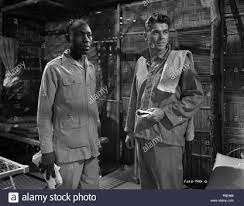
Executive Producers Jayjay Epega and Baba Epega are delighted to announce a collaboration with Turner Classic Movies in the US. The media outlet will feature a celebration of the movie career of Orlando Martins, who was the first Nigerian to forge a Hollywood Career in its golden era. The television special due in 2019 will cover a series of his films and interwoven discussions will be shown on the channel, and will feature family members, descendants of previous co-stars and other notable film industry stalwarts. The project is being pulled together by Charles Tabesh – SVP, Programming and Production at Turner Classic Movies / FilmStruck – TCM and his team. Tabesh said, “I do love the idea of doing an Orlando Martins night of programming on TCM – I didn’t know anything about him – his career is an important part of Cinematic history that should be acknowledged”.
Orlando Martins was the great uncle of Event Guru Baba Epega and Media Consultant Jayjay Epega. He was described as “a tall, powerful figure of a man with a deep bass voice, friendly, hospitable and with a grand sense of humour.” Martins, a native of Lagos, began acting on stage in London. Born in 1899 to a family of Ijebu and Amaro (Brazilian emancipado) descent, his parents and grandparents were steeped in the sometimes harmonious, sometimes conflicting traditional and cosmopolitan lifestyle of colonial Lagos. His father was a civil servant and part of the educated elites of that era. Orlando Martins was enrolled in Eko Boys High School in 1913. He worked briefly as a bookkeeper with a French produce-buying firm before he left Lagos in 1917 as a stoker on a merchant ship. In London, he joined a circus in 1919, worked as extra in a ballet company and in 1920s silent films. He was a singer in the Mississippi chorus of the Theatre Royal production, Show Boat, in the 1930s. He also made one of his most enduring career relationships around this time when he appeared on stage with Paul Robeson in Stevedore (1935) and Toussaint L’Ouverture (1936). He first met Robeson on the set of Sanders of the River in which the great American tenor played Mosambo, the lead character. Orlando and Jomo Kenyatta, the man who became the first president of independent Kenya, were both cast as extras in the film.
The two film roles for which Orlando Martins received the review were shot after WW II when he was arguably the best known black character actor in Britain. The role of Moghale, the influential witch doctor in Man from Two Worlds endeared him to the film going public but it did not improve his career prospects significantly. The character portrayed a friendly African native, the typical typecast of black actors as exotic, two-dimensional backdrop for white settlers, missionaries or adventurers. There were lots of exchanges and collaborations between European and Hollywood film makers at this time and Orlando struggled to secure realistic and challenging roles. He was part of a group of UK-based black entertainers who tried to form a Foundation for Negro Theatre in London. Their mission was to provide a forum to show the breadth of talents in the black community but the foundation never took off. Orlando did get other employment on stage and screen in Hollywood and London. He played Blossom, a Basuto warrior on the stage and screen production of Hasty Heart. The screen version starred Ronald Reagan, 40th president of the US. He appeared on the stage adaptation of Cry, the Beloved Country in London’s Trafalgar Square (1954), and The Member of the Wedding at the Royal Court (1957).
Orlando Martins’ second television role was the character John Kumalo in Cry, the Beloved Country (ITV, 1958), before that he played the runaway slave, Jim, in BBC’s Huckleberry Finn (1952). The 1950s was probably his most productive decade. In addition to stage and television, Orlando was typecast in no less than ten films including Where no Vultures fly (1951), The Heart of the Matter (1954), West of Zanzibar (1954), Simba (1955), Safari (1956), Tarzan and the lost Safari (1957) and The Nun’s story (1959) which starred Audrey Hepburn, who was a dear friend. He returned to Lagos in 1959 on the eve of Nigeria’s independence and went into semi-retirement. He accepted only film roles in the 1960s and was more selective about the characters he chose to play. He played the character of tribal chief in three films, Mister Moses (1965) which starred Robert Mitchum , Call Me Bwana (1963) which starred Bob Hope and Killers of Kilimanjaro (1960). Martins embarked on the last phase of his acting career in 1970, he took what was probably the most dignified character he ever played when he was cast as Dr. Gbenga in the screen production of Kongi’s Harvest, he also worked on the film version of Chinua Achebe’s Things Fall Apart (1971).
Martins’ stage, screen and television portfolio made him one of the most recognized names and face in entertainment at this point in his career. In spite of the limited range of character portrayals, he was severally honored in all the places he called home. In 1970, he became one of the first black actors recognized for his contribution to British films, he was awarded honorary life membership of the British Actors’ Equity Association. In 1982, Orlando was one of the honorees who received Nigeria’s national awards, he was recognized with the medal of Membership of the Order of the Niger (MON). Not to be outdone, the government of Lagos, his home state, made him an advisory member of Lagos State Arts Council, the executive body in charge of all cultural activities and infrastructures in the state. He held that position till he passed on in 1985 after which the State founded the Orlando Martins Awards in his honour.
Visit Orlando Martins’ imdb page to explore more of his work :
Twitter Tribute page : https://twitter.com/ThePaOrlando


